

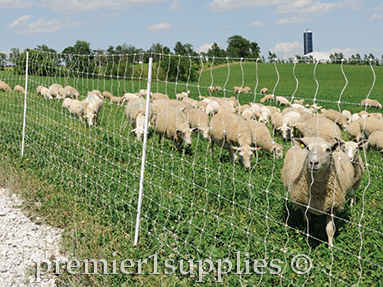
Sheep
Select The Best Fence Design For Your Site
Let Premier help decide which fence is best for you. Choose from:
Temporary Fences...
Boundary sites?
Electric netting is the best temporary boundary fence. Why? Because sheep, goats, dogs and most coyotes cannot penetrate it and, after a single shocking event, don't try to jump it.
Specific suggestions:
- Use 35" ElectroNet® only if animals are trained to netting and are neither tall nor flighty. It's less $$ and easier to use than other netting.
- Use the taller ElectroStop® or ElectroFence® for flighty animals.
Internal sites?
- Netting is more reliable but also more expensive per ft to purchase.
- But 2 to 3 strands of IntelliRope® 4.5 or IntelliTwine™ on reels are much cheaper per ft than netting. Multi-strand fences like this will stop most adult ewes and feeder lambs. But it is less able than netting to stop coyotes, dogs, young lambs/kids, dairy goats, hungry sheep or rams/billies during the breeding season.
Semi-permanent Fences...
What do we define as a semi-permanent fence? One that will be moved monthly to once a year (we reset some of our PermaNet® 10/48/6 fences in the spring and leave be until the next spring). Characteristics are taller and thicker posts and more conductors than temporary fences.
Specific suggestions:
- PermaNet®, ElectroFence® or QuikFence®. Faster to install and remove than 4 or 5 strand fences. More expensive but more reliable. All must be electrified.
- 3 to 5 strand electrified multi-strand fences. Much less expensive. Less reliable than the netting options. Multi-strand fences, by definition, lack vertical strands—vertical strands increase visibility and act as a psychological barrier to livestock. And multi-strand fences need stronger end and corner posts because the strands are tensioned.
Unique Situations...
Floodplain sites?
We use a 5-strand fence composed of:
- IntelliRope® 4.5 below the normal high water level.
- MaxiShock™ above that.
- Wood line posts. (Wood posts resist the side pressure created by floods better than steel or fiberglass.)
The flood will break the IntelliRope™ and leave the posts and MaxiShock™ in place. It's easy to fix the IntelliRope™.
Water gaps?
- Old or damaged electrified netting supported by extra FiberRods. Each flood will degrade or remove it.
- Or install up to 4 strands of live tape/twine on 1/2" fiberglass rods. This is much cheaper than net, less likely to tangle and easily repaired—but less reliable against creative animals.
Field gates?
- Temporary gates? Use ElectroNet® Gates or ElectroFence® Gates. Repels coyotes and dogs as well as livestock. Can be adapted to any length. Low cost. Easy to install.
- More permanent gates? Premier's 4-ft tall welded wire panels (though some guard dogs crawl over them.)
- For electrified netting just remove the end post and pull the net back to let animals/machines in/out.
To Reduce Risk and Liability...
Are electric fences a serious safety risk to humans?
Because touching an electric fence is painful and the voltages are high, most assume that the risks from an energized fence must also be high. That's a myth. Consider that millions of people throughout the world are "exposed" to millions of electric fences every day—yet they are involved in (but are not always the cause of) less than one human death or serious injury per year worldwide. Compare that to the number of annual injuries and deaths that occur from human exposure to tractors, skid loaders, ladders, PTO shafts, balers, mowers, combines, bulls, stallions, rifles, shotguns, knives, etc. This is not to suggest that there is no risk at all. There is, indeed, a small level of risk. And with risk, there is also liability to the fence's owner.
What NOT to do!
- Never place your head or upper spine near an electrified wire. Accidental head or neck contact can occur when pushing a voltage probe into the soil. Be careful when doing so to avoid head-to-wire contact!
- Never attempt to step over or climb through an energized fence of any kind.
- Never encourage anyone to touch an electric fence.
Warning!
In 1991 an accidental fatality occurred when a young child's head contacted an electrified fence while the child was crawling on wet grass. The fence was correctly installed and functioning properly. The energizer was a UL approved unit. As a result, Premier strongly advises against allowing toddlers access to any electrified fences. Also, due to this incident and others, experts now suggest that human contact by an energized wire to the head and neck may be the most dangerous point of contact. We urge all to especially avoid this kind of contact.